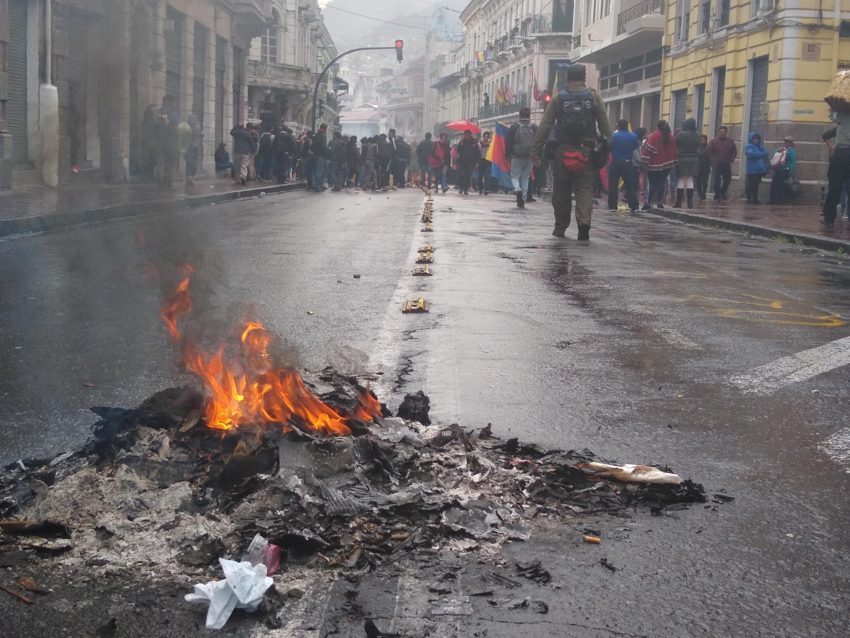
Ominous images of riot police on horseback flanked by fires in the streets and framed by clouds of teargas in the background are painting a disconcerting picture of chaos and violence in Quito, the capital city of Ecuador. While the news reports of President Moreno’s declaration of a state of emergency throughout the country are technically accurate, the situation on the ground is not nearly as dangerous as the sensational headlines would have you believe.
Earlier this week, tens of thousands of Ecuadorians took to the streets of the country’s major cities to protest the abrupt cancellation of fuel subsidies, which had been in place for 40 years. Overnight, gasoline prices skyrocketed, driving up the price of bus fares, food, and everyday products. In addition, tens of thousands of government workers will be laid off, others will receive a significant pay cut, and some state-owned assets will be privatized. The austerity measures were prompted by International Monetary Fund targets that the country must meet in order to continue borrowing money from the World Bank and other international funders.
For Ecuadorians living on the margins, the end of gasoline subsidies will bring unaffordable price increases for transportation, food, clothing, and everyday goods for the foreseeable future. A young woman I met on the street told me her mother had bought a sack of potatoes for $3.25 a few days ago, and the price had already increased to $4.50. For a country with an average income of $400 per month, this kind of increase is devastating for many families.
For tourists, the protests prevented travel to or from the airport, and local museums and tourist attractions were closed. Some airlines canceled flights while others scrambled to book passengers into accomodations near the airport. This meant that visitors stuck in the city were able to keep their hotel rooms, as those scheduled to arrive couldn’t get to town to displace them.
In response to the sudden, drastic changes, taxi drivers went on strike, and citizens crowded around government buildings demanding that the President back down or resign. Protesters blocked streets in and around downtown Quito, forcing bus drivers and private car owners to abandon their routes and make U-turns. Police also blocked intersections, diverting pedestrians away from the presidential palace and public plazas. In isolated incidents, young men with bandanas over their faces broke up curbs and sidewalks to throw at police. Riot police confronted the crowds on foot, motorcycle and horseback while armored vehicles roamed the streets near the historic center of town.
Scott and I attempted to visit a particular pharmacy to refill a prescription, but were turned back by drifting tear gas, which burned our eyes, seared our sinuses, and coated our throats. Later, when we tried to access the meeting point for an out-of-town tour to Mitad del Mundo and Museo de Intanan, we were again thwarted by drifting tear gas. Later that evening, street closures prevented us from reaching a nearby brewery, so we opted for another local eatery. Afterwards, while enjoying a glass of wine at another restaurant closer our AirBnB apartment, the manager sprinted into the dining room to close doors and windows while the kitchen staff escaped into the courtyard, coughing and rubbing their eyes due to another tear gas attack. After we finished our wine, the same manager, along with the restaurant owner, insisted on escorting us home, despite our assurances that we only had four blocks to walk.
Smaller protests continued the following day, but they were mostly contained by police. On the way to a market famed for its chancho hornado (slow-cooked pork), we walked past a crowd of protesters who temporarily blocked a main road leading into the heart of Quito. Sadly, the market was closed, and by the time we passed back through, the police had established a human barrier along the sidewalk, behind which protesters chanted slogans, honked vuvuzelas, and hoisted homemade signs saying “Fuera FMI” (IMF Out!) and “Fuera Moreno” (President Moreno Out!).
Now that the weekend has arrived, life has returned to normal in the streets of Quito. But protests are slated to ramp up again starting Monday. We have plane tickets to Cali, Colombia on Wednesday, and we are hoping we will be able to find transportation to the airport to use them. If not, we’ll extend our stay in Quito, and continue monitoring the situation. Stay tuned.